

FulfillmentLast updated
Shopee Commission Fees: Breaking Down Costs & Multi-Channel Strategies
Shopee's commission fee changes frequently. What fees cost on one order, and the checks that tell you it's time to add a second channel.
Shopee's commission fee is the share of each completed order that Shopee keeps for selling on its marketplace.
From 14 August 2026, Shopee Malaysia charges local Marketplace sellers anywhere from 13.5% to 17.0% depending on their category, with lower rates for sellers in the Shopee Cashback Programme (SCP), plus 8% SST
Once you add the transaction fee and the platform support fee, a RM100 order can cost about RM21 in fees.
If most of your sales come through Shopee, every change to that table lands on your margin.
Understanding Shopee’s Per-Order Fee Structure
Local Marketplace sellers pay no registration or listing fee. The charges come when an order completes, and Shopee deducts them from your payout. Three apply to almost every order.
The commission fee is a percentage of the sale. Shopee sets a range for each category group, and the rate within that range depends on the sub-category your product is listed in.
SCP is an opt-in programme in which Shopee funds vouchers and coins cashback for your buyers. Members get a lower commission rate but pay a programme service fee of 5.5% of the sale, or 7.5% on campaign days, capped at RM100 per item and subject to 8% SST.
The transaction fee covers payment gateway costs. It is 3.78% after SST of the final amount the buyer paid, shipping included.
The platform support fee is a flat RM0.54 per completed order, after SST.
Two more charges can apply. When an order goes through a refund or a return and refund, the logistics partner's forward and return shipping costs come back to you as an unsuccessful order fee, plus 6% SST. Optional services, such as the Cashback Programme or pre-order listings, carry their own fees.
Analyzing the Cumulative Impact of Marketplace Fees
Take a scented candle listed under Lifestyle at RM100, with RM5 shipping paid by the buyer. Assume a commission rate of 15%, in the middle of the non-SCP band. These figures are illustrative.
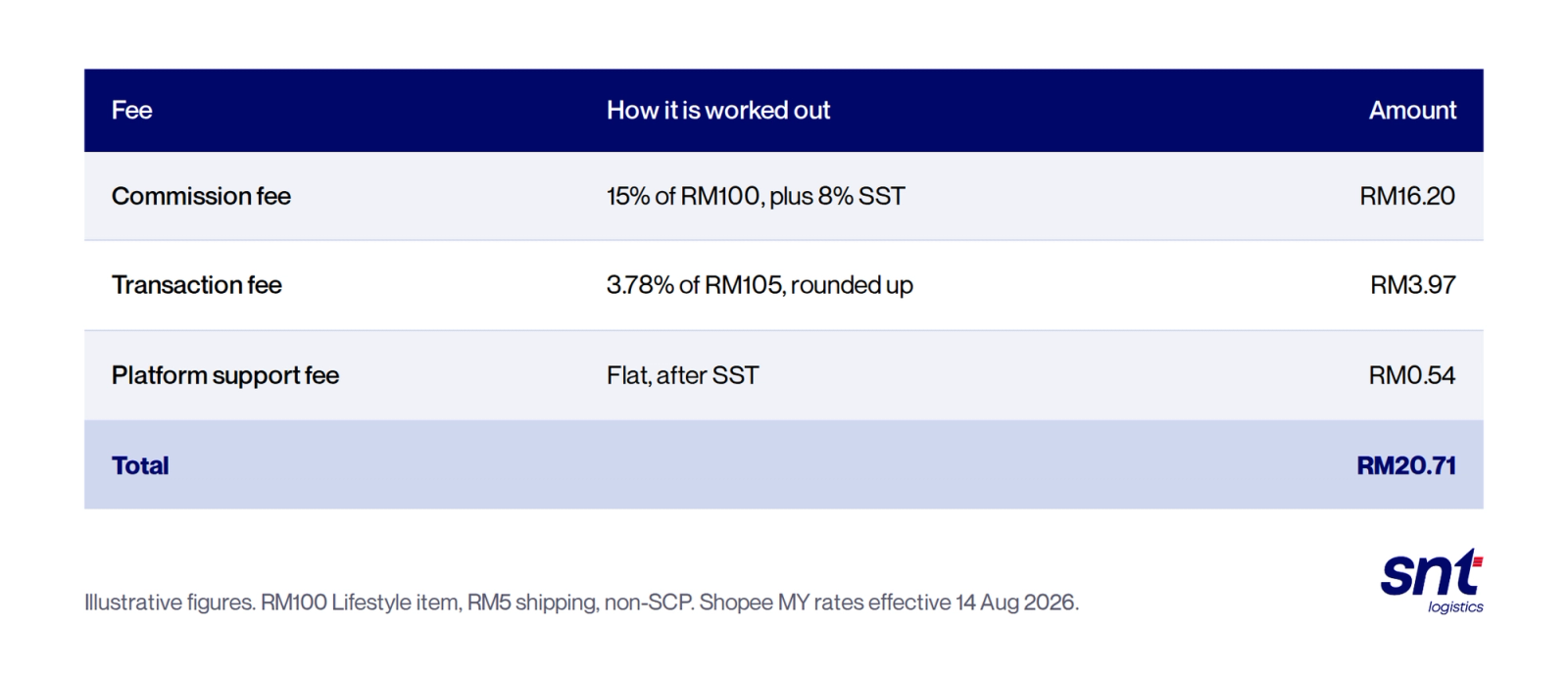
That is about a fifth of the item price, before you pay for the candle, the packing or the delivery. We have assumed commission is charged on the item price. Check the fee breakdown on one of your own completed orders for the exact base.
The fee change on 14 August 2026 shows how quickly this moves. Shopee cut the SCP commission discount from 5% to between 2% and 3.5%, depending on category. For Lifestyle sellers in SCP, the old range of 8.5% to 11.5% became 11.0% to 14.0%. A seller in the middle of that band now pays RM2.70 more on a RM100 item once SST is added.
Across 2,000 orders a month, that is RM5,400 a month, without anything changing in your own business.
Key Indicators It’s Time to Expand Beyond Shopee
Shopee brings you buyers you would struggle to reach on your own, so these checks test something narrower: whether one platform should carry all of your sales. Each one runs on your own numbers.
Start with cost. Pick a limit for what selling on a channel may cost as a share of the order, based on your margin. Then add your Shopee fees to your packing and delivery cost per order, which our guide to reducing logistics costs shows how to work out. If the total sits above your limit for three months running, the channel is costing more than you planned for.
Then test how exposed you are. Rerun the worked example above with your own rate and volume. If an increase like August's would take a month's profit with it, your business depends on decisions made in Shopee's office, and a second channel spreads that risk.
Next, look at who your customers come back to. If a good share of your orders come from repeat buyers or people who search your brand name, they may follow you to your own web shop, where there is no marketplace commission. You still pay for a payment gateway and for the traffic you bring in, so price those in before you compare.
Last, check your stock. Most of the trouble with a second channel is operational. If you hold separate stock for Shopee and Lazada, or Shopee and TikTok Shop, one sells out while the other sits full. Selling from one stock pool, with every channel drawing on the same shelf, keeps a test channel from tying up cash.
If two or more of these point to a second channel, start with one channel and a small range of best sellers. Run it for a full quarter, then compare its fees and fulfilment cost per order with Shopee's.
Adding a channel is easier when the stock and fulfilment behind it are already shared. If you are weighing a second channel and want one stock pool behind both, contact us for a free quote.
Frequently Asked Questions (FAQs)
Is SST charged on top of Shopee's commission fee?
Yes. Shopee adds 8% SST to the commission fee. The transaction fee of 3.78% and the RM0.54 platform support fee are already quoted after SST. Unsuccessful order fees carry 6% SST. Check your order fee breakdown in Seller Centre to see each line.
When does a new Shopee seller start paying commission?
From 1 August 2026, commission applies once your first listed product is more than 120 days old, or once you have more than 200 completed orders, whichever happens first. Until then, the transaction fee and the platform support fee still apply.
Do all product categories pay the same Shopee commission rate?
No. Each category group has its own range, and some categories pay less or nothing. Shopee says more than 100 categories have had waived or reduced commission since 21 May 2026, and added Essential Goods categories from 1 August 2026.
What happens to my fees when a Shopee order is returned?
On an order approved for refund or return, you are charged an unsuccessful order fee. It covers the logistics partner's forward shipping fee and return shipping fee, plus 6% SST. This applies to unsuccessful orders from 9 May 2022 onwards.
How often does Shopee change its seller fees?
There is no fixed schedule. Shopee's fee page alone lists changes effective 21 May, 1 August and 14 August 2026. Check the Fees for Local Shopee Sellers page in Seller Centre before you set prices for a campaign or a new range.
Read more
Omnichannel vs Multichannel Fulfilment: Which Setup Is Right for Your Brand?
Omnichannel vs multichannel fulfillment: separate stock per channel, or one stock count for all. What each does well, and the signs it's time to switch.
3 Signs Your Fulfillment Service is Holding You Back
Is your fulfillment service falling behind? Three signs to check: missed cut-offs, errors you hear about from customers, and requests that take a week.
Which 3PL Provider in Malaysia is Right for Your Lifestyle Brand?
3PL providers in Malaysia compared: DHL, Ninja Van, Locad, URSTORE, SNT and marketplace fulfilment, and which type suits which kind of brand.
How Packaging Improves the Customer Experience
How packaging shapes what customers think of a brand, and how a 3PL keeps it consistent across parcels, bundles and retail deliveries.